|
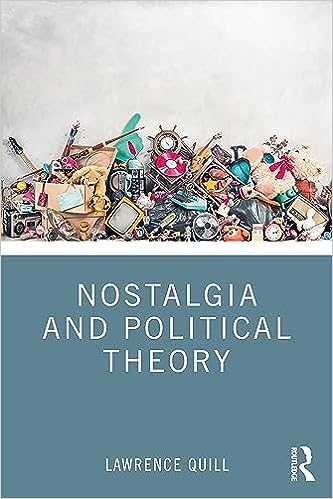
Nostalgia and Political TheoryIn Nostalgia and Political Theory, Lawrence Quill advocates the central importance of nostalgia as a theoretical response to the ‘historic’ past and a vertiginous present. He does so by offering detailed analyses of diverse theoretical approaches, from the ancient world to the modern day, in order to reassess the relation between nostalgia and politics. Quill proposes nostalgia as an organizing concept, silently (and not so silently) influencing theorists as they construct critiques of the present or visions of the political future.
Nostalgia and Political Theory surveys key contributions to nostalgic and anti-nostalgic thinking from across the political spectrum. Assessing the influence of photography, radio, television, and personal computing on changing conceptions of the past, Quill also considers the relation between populism, nationalism, and nostalgia. By challenging those who would dismiss nostalgia as irrational or a symptom of cultural malaise, Quill concludes by advancing the case for a liberal theory of nostalgia. Routledge 2024 |
|
Secrets and Democracy:
|
|
Civil Disobedience:
|
|
Liberty After Liberalism:
|
Selected Articles
“Post-Humanism and the Road to Castle Frankisstein”in What We Think About When We Think About Love.
(Bloomsbury Academic Press, 2021)
"The Californian Ideology Revisited" (with Professor Hasmet Uluorta)
in Digital Platforms and the Algorithmic Self (Westminster University Press, 2021)
“All the World’s a Simulation” in Playing with What is There. (Routledge,, 2021)
“The Software Will See You Now.”
Counseling and Psychotherapy Research, 21,3, 498-501, 2021.
"Should A.I. Be Your Therapist?"
Philosophy in the Contemporary World: An International Journal
(Spring/Fall 2020)
“The Case of Canvas: Longitudinal Datafication through Learning Management Systems”
(with Professor Roxana Marachi) Teaching in Higher Education Special Issue (April 2020)
"Silicon Valley's Basic Income" (with Professor Hasmet Uluorta)
(September 2017)
"Technological Conspiracies"
Critical Review: A Journal of Politics and Society, 28(1) (2016)
"Tea with Zizek" (with Professor Hasmet Uluorta)
Psychotherapy and Politics International, 13(3) (2015)
(Bloomsbury Academic Press, 2021)
"The Californian Ideology Revisited" (with Professor Hasmet Uluorta)
in Digital Platforms and the Algorithmic Self (Westminster University Press, 2021)
“All the World’s a Simulation” in Playing with What is There. (Routledge,, 2021)
“The Software Will See You Now.”
Counseling and Psychotherapy Research, 21,3, 498-501, 2021.
"Should A.I. Be Your Therapist?"
Philosophy in the Contemporary World: An International Journal
(Spring/Fall 2020)
“The Case of Canvas: Longitudinal Datafication through Learning Management Systems”
(with Professor Roxana Marachi) Teaching in Higher Education Special Issue (April 2020)
"Silicon Valley's Basic Income" (with Professor Hasmet Uluorta)
(September 2017)
"Technological Conspiracies"
Critical Review: A Journal of Politics and Society, 28(1) (2016)
"Tea with Zizek" (with Professor Hasmet Uluorta)
Psychotherapy and Politics International, 13(3) (2015)